PAGE CONTENTS
Objectives
The overall objective of this activity is to study, derive and verify technical constraints and requirements for an economically feasible system for mobile multimedia reception in vehicles for Ka-band satellite systems without dedicated terrestrial repeaters. The aim of the system is to deliver attractive services (from both the technical as well as the commercial point of view). Proving the technical feasibility of the chosen approach is accomplished by a dedicated computer simulation. Another objective of the project is the creation of a technological roadmap for the identified critical components, allowing the development of such components to be based and influenced by the findings in this project.
Challenges
Attempts at satellite services for mobile multimedia consumption for different frequency bands have, with very few notable exceptions, been not very successful in the market so far. One of the main challenges for this activity is therefore to derive system requirements, antenna characteristics and service parameters which are both commercially and technically sound while remaining attractive for the end-user and service providers alike. The main focus lays here on the mobile end-user antenna terminal, the total cost of ownership (TCO) and the identification of geographical, vehicle-class and content differentiated markets.
From the point-of-view of the physical layer simulation, the incorporation of a realistic channel models and simulation parameters for real-world applicable results can be identified as crucial. Nevertheless this is a precondition for deriving a reliable technological roadmap.
System Architecture
The overall system architecture consists of
- The space segment with a Ka-band transmitting satellite and being supplied with content via an (RF, Ka-band) feeder link
- The end-user antenna terminal featuring a (tracking) antenna and a modem
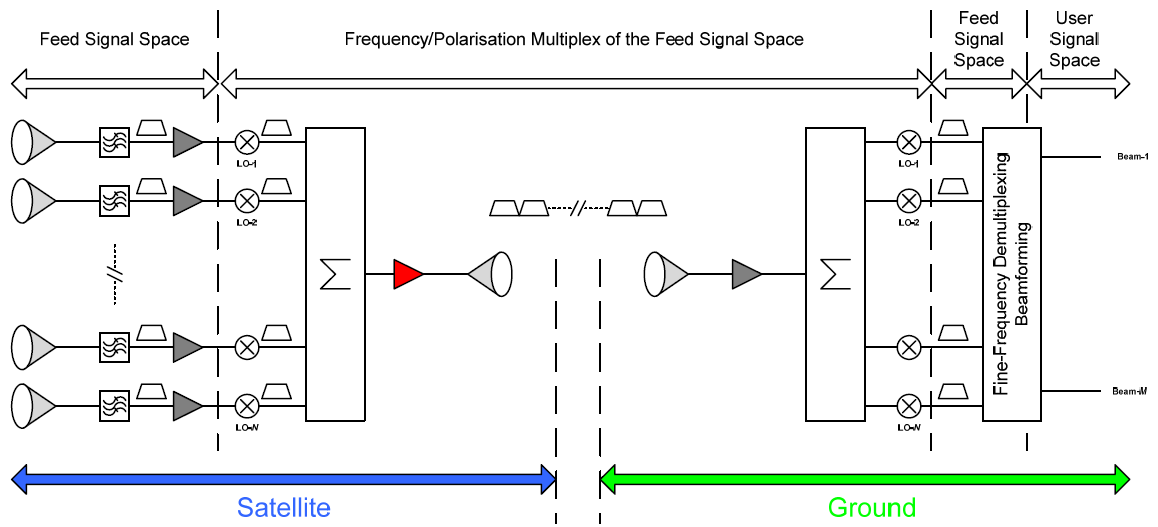
The focus in this activity is firmly with the mobile end-user terminal but typical configurations and limitations imposed by the space segment and the content delivery chain are also taken into account.
Plan
The project is organized into four tasks, resulting in the following structure and milestones:
Task 1: Service and System Consolidation
- MS1: System Requirement Review (SRR)
Task 2: System Detailed Analysis and Trade-offs
- MS2: Baseline Design Review (BDR)
Task 3: System Performance Assessment
- MS3: Critical Design Review (CDR)
Task 4: Cost Analysis and Technological Roadmap
- MS4: Final Review (FR)
Current Status
The project is successfully completed.