
PAGE CONTENTS
Objectives
In order to identify the best potential opportunities for European satellite service providers through this study the project plans to answer the following general questions:
- What are the technical and economic conditions that will make satellite networks attractive to be integrated with terrestrial IP cloud-networks?
- How do these conditions and requirements impact on satellite networks – their service delivery and assurance operations as well as on their technical and business effectiveness and efficiency?
- What are the requirements on the interfaces that will provide for interoperability at the orchestration (service and business), management (control and monitoring) and user-data layers?
- What developments need to take place to support interoperability between satellite and terrestrial cloud-networks?
The basic deployment assumption is the existence of local mobile networks that are able to connect through satellite networks a set of wireless devices to a set of services which are deployed in public or private data centres using specific state of the art cloud technologies. In addition a local micro-data centre may be deployed together with the local mobile networks to support local connectivity as well as the aggregation and distribution of remote communication services according to the specific characteristics of the satellite network. The micro-data centres are represented by medium- to small- scale deployments of server clusters across a wide geographic area, for instance covering a remote rural area or a cargo ship.
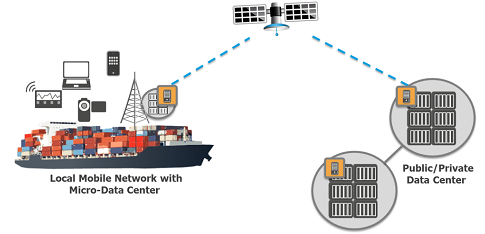
Challenges
- Forecast the evolution of existing services over the next ten years.
- Identify and study future uses and services that could emerge in the service-verticals of content management, data distribution and of information collection and data dissemination in view of current trends, notably including the availability (always on, everywhere), the development of mobile terminal equipment and services, of ‘cloud computing’, the Internet of Things and Machine Type Communications, the delivery of new types of content such as HD / 3D videos, the data and traffic tsunami, as well as the rising societal and environmental concerns and the quest for the improvement of energy efficiency, and describe typical architectures including operational models.
- Identify, analyse and characterise the state of the art in cloud-networking techniques and technologies for terrestrial networks (wired and wireless) in Europe, US and world-wide covering the solutions, their standardisation, validation (standard conformance and testbeds), deployments and alignment (consensus/ divergence) and propose classification schemes based on detailed performance, deployment, orchestration / re-configurability, management (control / monitoring), scalability / elasticity, security / privacy, service delivery modality / protocols and charging, pricing and regulations dimensions.
- Assess the new constraints and requirements (including co-operation, economic, technical and trust / security / privacy) that will be imposed on the terrestrial telecommunications cloud -network and -service infrastructures in order to provide assured QoE / QoS in multi-domain provisioning environments.
- Define integrated satcom – terrestrial cloud-networks service delivery architectures, validate and benchmark (via real testbeds and simulations) and suggest guidelines for evolutionary implementations answering questions such as:
– What are the possible value-added scenarios for terrestrial and satellite cloud-networks integration in the content management or distribution and information collection and dissemination verticals?
– What are the associated markets and business incentives for each?
– What is the mix of services that would be offered over each and which is their expected introduction priority? What are the advantages and disadvantages of GEO and non GEO (LEO/MEO) network topologies in each case?
– What are the service delivery architectures (covering all business, operational and technical dimensions) most relevant to these and what are the expected deployments in the short, mid and long-term?
– What terrestrial cloud-networking technologies can be re-used and what are the necessary adaptations and enhancements for the satcom networks?
– What are the measures and KPIs that enable the evaluation and benchmarking of the validation use cases and how do these map to the physical layer and network performance metrics?
– What are the impacts on the CAPEX and OPEX for the satellite component per system use-case?
Make recommendations for future work based on the definition of a multi-layered roadmap of ranked actions (technology, standardisation, dissemination) and identify future experimentation/demonstrations over the air that could be implemented to further validate the concepts the air that could be implemented to further validate the concepts
Plan
The project started in October 2014, and is planned to run for 15 months.
It is basically structured in four main consecutive actions. The initial activity Task 1 focuses on the analysis of cloud networking techniques and technologies for terrestrial wired and wireless networks, which is followed by an activity (Task 2) concerned with the assessment of dimensions of suitability for integration with satellite networks and integration scenarios.
The first phase of the project that includes the above two activities will conclude by the “Cloud Networking and Techniques and Technology Review”.
The CNTTR is followed by Task 3, Integrated cloud networking architecture(s) definition and validation. This activity concludes with a checkpoint, the Integrated Architecture(s) Review, before the final activity called Future work recommendations, technology development roadmaps and standards evolution can kick-in. The study is expected to conclude with a FR after month 15.
The project has been extended, both timewise and scopewise to produce a white paper assessing satellite-terrestrial integration opportunities in the 5G environment.
Current Status
The project has completed successfully. INSTINCT demonstrated the feasibility of satellite networks integration with terrestrial clouds to dynamically and optimally offer services, and validated and benchmarked selected options in real testbeds and via simulations.
INSTINCT also produced a white paper assessing satellite-terrestrial integration opportunities in the 5G environment.