PAGE CONTENTS
Objectives
The main objective of the activity was to study and demonstrate new architectures for low-cost mobile terminal antennas suitable for linearly polarized satellite links. Two scenarios were identified, one for a transmit-only (Tx), and another for a receive-only (Rx) antenna. The Tx scenario is the classic beam-switching scenario, where the field of view of the antenna is divided into a number of sectors, and the antenna generates a beam to cover each of these sectors. The objective was to find ways to reuse the aperture for all beams of the switched-beam set, without requiring a separate beam-forming network for each beam.
A switched beam approach was attempted for the RX antenna, but due to its size (and the number of beams to switch between) it was found impossible to implement. An alternative approach was decided, again attempting to avoid any costly proprietary MMIC design, this time by using 1 bit phase shifters with off-the-shelf diodes.
The crude quantization of the phase controls results in high sidelobes and polarization errors if naively implemented.
The objective was to demonstrate ways to control these drawbacks.
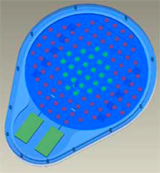
Figure 1 – TX and RX antenna EBBs

Challenges
The main challenges addressed in this activity are the following:
- Low cost
Both the antennas innovative concepts were drawn having in mind a reduction in cost, when compared to classical approaches. This was achieved thanks to a reduced number of switches and beamforming layers in the TX antenna and a one bit cell, aperiodic spacing and rotation of the elements in the RX one. - No phase shifters
Both the antennas were designed to work without any special MMIC covering the required FoV. In the RX case the antenna was also able to turn the linear polarization to adjust for a usage in different world locations.
Plan
The activity has been executed in two main phases:
Review of requirements and specifications and Baseline Design Requirements have been reviewed with the customer and final specifications have been set accordingly. At this point the design was split between TX and RX antennas. The initial architectures have been studied and traded-off in a Baseline Design. Critical Breadboard have been manufactured to limit the risks.
Antenna EBBs Design , Manufacturing and Measurement
Design and development of the Tx and RX antenna EBBs. Both boards have been tested in the anechoic chamber according to the test plan approved by ESA. The results were used for drawing conclusions.
Current Status
The project has been successfully completed. The prototypes of the TX and of the RX antennas have been manufactured and tested. Both TX and RX antennas results demonstrated the capabilities of the studied concepts.